There is a strange kind of silence that comes after obedience.
You prayed. You moved. You confessed. You forgave. You sent the message. You opened your hands and surrendered the thing you had been gripping so tightly. You did what you believed God was asking you to do.
And then…
Nothing.
No thunder. No immediate answer. No sudden opening of the heavens. Sometimes there is not even a feeling of peace afterward. There is simply the quiet realization that you have done what you could do, and whatever happens next belongs to God.
I think this is one of the hardest places to live.
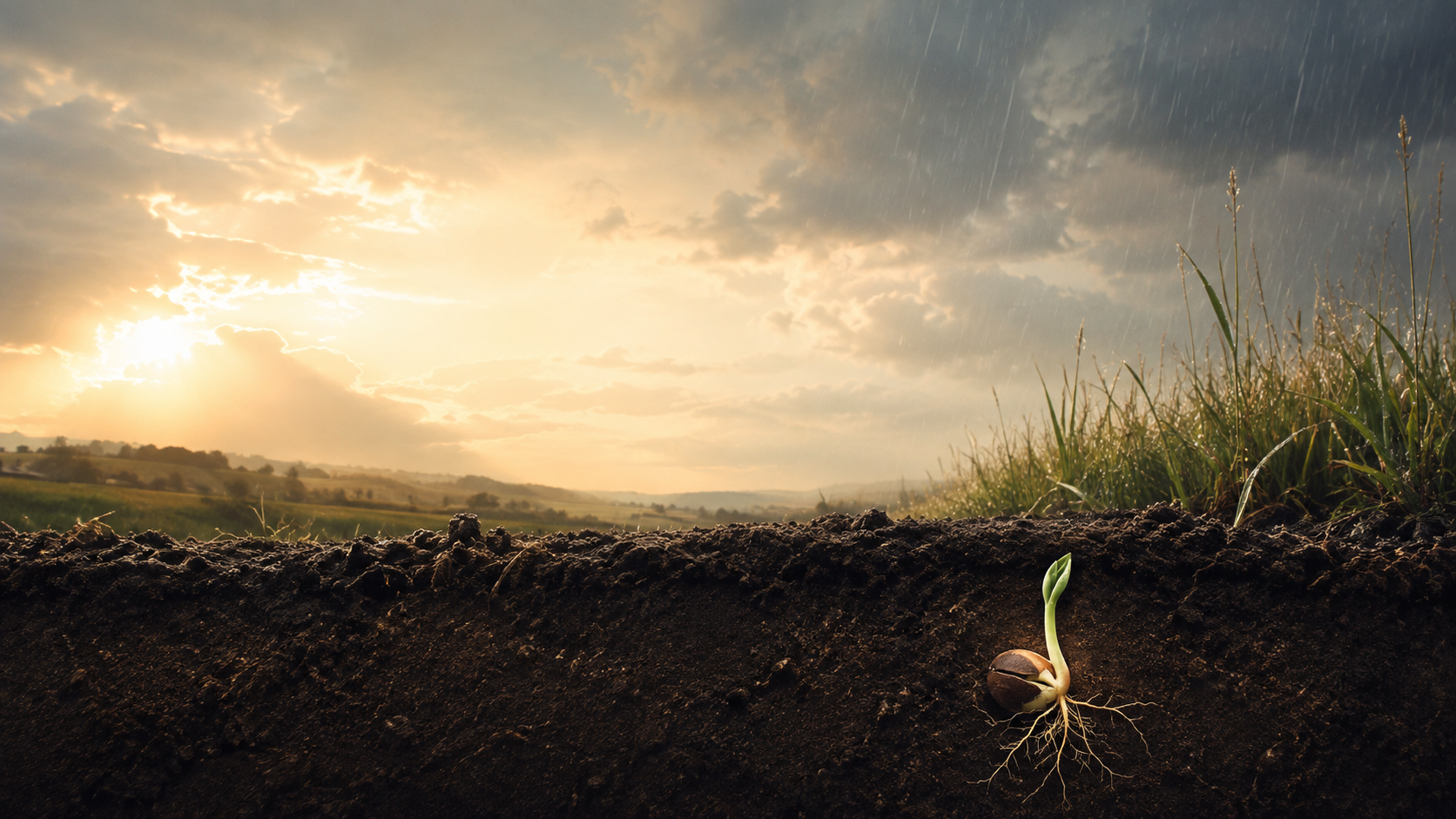
We like beginnings because beginnings are full of possibility. We like harvests because harvests give us something we can hold. But between the seed and the harvest is dirt.
Dark dirt.
You cannot see what is happening underneath it.
Jesus said,
“The kingdom of God is like a man who casts seed upon the soil; and he goes to bed at night and gets up by day, and the seed sprouts and grows—how, he himself does not know.”
Mark 4:26–27, NASB 1995
I love that little phrase:
“How, he himself does not know.”
The farmer does something remarkably ordinary. He throws seed into the ground.
Then he goes home.
He sleeps.
Morning comes. Evening comes. Another morning. Another evening.
Meanwhile, beneath soil he cannot see through, something is happening that he cannot manufacture.
Life is unfolding in the dark.
That is difficult for people like me.
I want to dig.
I want to brush the dirt away and make sure the seed is still there. I want measurements. I want progress reports. I want God to explain whether we are currently at twenty-seven percent germination so I can update the spreadsheet accordingly.
But digging up a seed every morning is a terrible way to grow a garden.
Sometimes faith means leaving buried things buried.
Not because nothing is happening.
Because something may be happening that I cannot yet see.
There are prayers in my life that have lived underground for a long time. There are people I love whom I want to see transformed. There are desires I have brought before God again and again. There are parts of my own heart where I have wondered why change seems so painfully slow.
Perhaps you know that place too.
You have asked God for something good.
And you are still waiting.
Waiting can begin to feel like evidence.
We quietly reason:
If God were working, surely I would see something by now.
But Scripture repeatedly refuses that conclusion.
Joseph received dreams long before he received authority.
David was anointed long before he sat on the throne.
Abraham received a promise long before he held Isaac.
Israel walked around Jericho while the walls remained stubbornly standing.
And Jesus Himself lay inside a sealed tomb while His disciples concluded that the story was over.
God has never been frightened by the space between promise and fulfillment.
We are.
That space exposes us.
It reveals whether our confidence was actually in God or merely in the outcome we hoped God would produce.
Paul wrote:
“For we walk by faith, not by sight.”
2 Corinthians 5:7, NASB 1995
I have often read that verse as though walking by faith means courageously marching into some enormous unknown.
Sometimes it does.
But perhaps walking by faith also looks much quieter.
Sometimes walking by faith means waking up Tuesday morning when Monday’s prayer still appears unanswered.
It means loving someone who has not changed.
It means resisting the temptation you thought would be gone by now.
It means opening Scripture again.
Praying again.
Showing up again.
Planting again.
Not because you can see the harvest.
Because you know the Farmer.
There is an important difference between trusting that something specific will happen and trusting God.
Faith does not give me authority to write the ending.
Faith gives me confidence to place the pen back into God’s hand.
Maybe the thing I planted will grow differently than I imagined.
Maybe God will answer the prayer differently than I requested.
Maybe the harvest will come years from now.
Maybe someone else will gather fruit from a seed I never lived long enough to see sprout.
Paul understood this.
“I planted, Apollos watered, but God was causing the growth.”
1 Corinthians 3:6, NASB 1995
There it is again.
Our part.
And God’s part.
Plant.
Water.
God causes the growth.
There is enormous freedom hidden inside that order.
I am responsible for obedience.
I am not responsible for resurrection.
I can speak truth, but I cannot make someone believe.
I can love faithfully, but I cannot transform another person’s heart.
I can confess sin, pursue wisdom, seek counsel, work diligently, pray earnestly, and plant good seed.
But eventually my hands reach the edge of what human hands can do.
And strangely enough, that edge is not where hope ends.
It is where providence becomes visible.
Or perhaps more accurately:
It is where providence continues working while remaining invisible.
So if you are standing over some patch of dirt today wondering whether God has forgotten what you buried there, resist the urge to dig it up.
Water what you can.
Be faithful with what is in front of you.
Then go home.
Eat dinner.
Laugh with somebody you love.
Sleep.
Wake up tomorrow and walk with Christ again.
The kingdom of God has been growing in places human eyes could not see for a very long time.
And somewhere beneath the soil—
perhaps beneath circumstances that presently look completely lifeless—
the God who raises the dead is still at work.
You may not know how.
The farmer didn’t either.
But morning is coming.


Leave a Reply