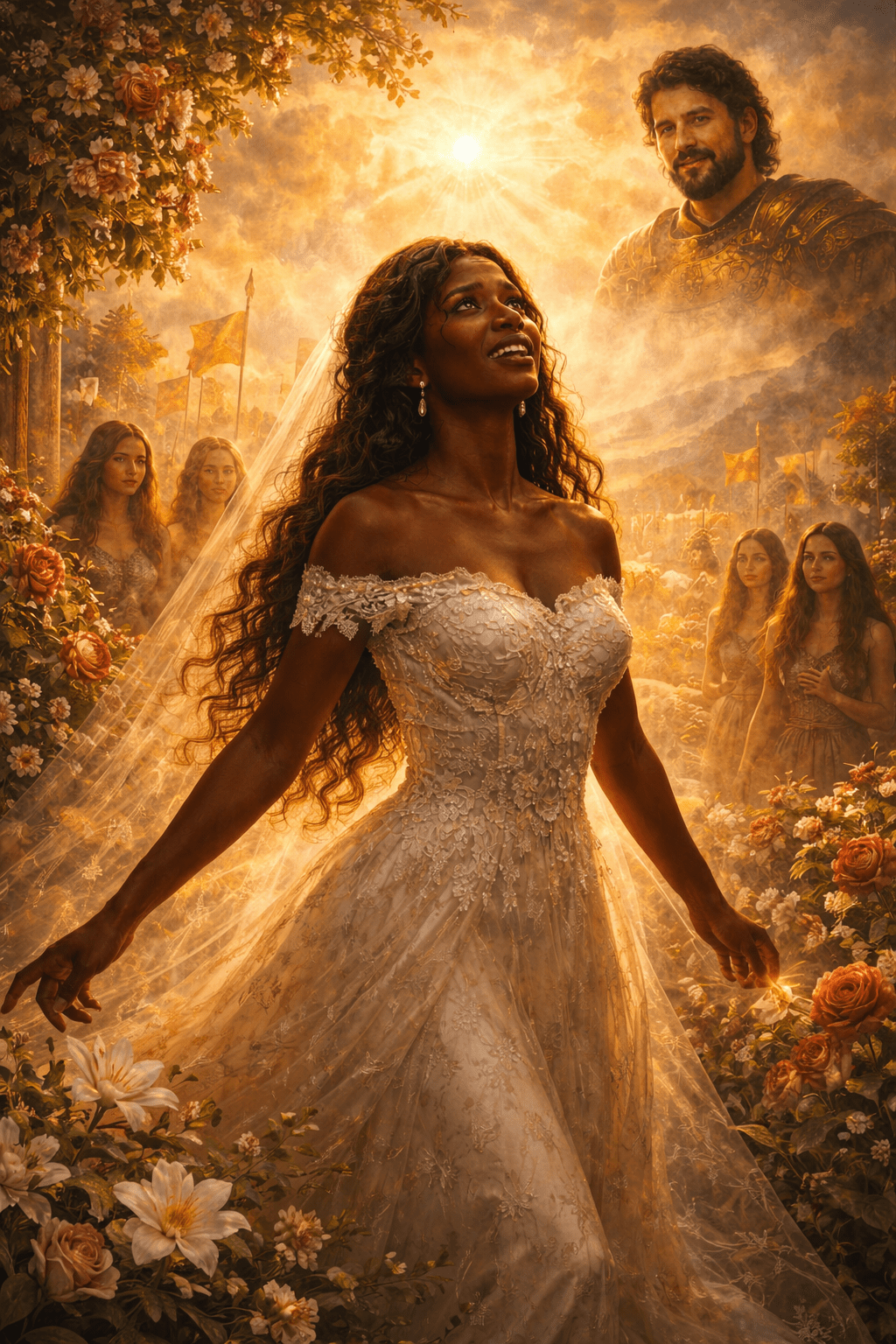
The Daughters Ask
“Where has your beloved gone,
You most beautiful among women?
Where has your beloved turned,
So that we may seek him with you?”
The Bride Answers
“My beloved has gone down to his garden,
To the beds of balsam,
To pasture his flock in the gardens
And gather lilies.I am my beloved’s and my beloved is mine,
He who pastures his flock among the lilies.”
The Bridegroom Speaks
“You are as beautiful as Tirzah, my darling,
As lovely as Jerusalem,
As awesome as an army with banners.Turn your eyes away from me,
For they have confused me;
Your hair is like a flock of goats
That have descended from Gilead.Your teeth are like a flock of ewes
That have come up from their watering place,
All of which bear twins,
And not one among them has lost her young.Your temples are like a slice of pomegranate
Behind your veil.There are sixty queens and eighty concubines,
And maidens without number;
But my dove, my perfect one, is unique:
She is her mother’s only daughter;
She is the pure child of the one who gave birth to her.
The young women saw her and called her blessed,
The queens and the concubines also, and they praised her, saying,‘Who is this who looks like the dawn,
As beautiful as the full moon,
As pure as the sun,
As awesome as an army with banners?’”
The Bride’s Recollection
“I went down to the orchard of nut trees
To see the blossoms of the valley,
To see whether the vine had flourished,
And the pomegranates had bloomed.
Before I was aware,
My soul put me over the chariots of my noble people.”
The Chorus Interjects
“Come back, come back, O Shulammite;
Come back, come back, so that we may look at you!”
The Bridegroom Answers
“Why are you looking at the Shulammite,
As at the dance of the two armies?”
Context and Meaning
The painful separation of chapter 5 gives way to restored nearness. The chapter begins with a communal search—but the bride now knows where he is: “My beloved has gone down to his garden…” The imagery returns to peace, to pasture, to lilies.
What follows is astonishing. The bridegroom speaks again—praising her with more glory than ever before. She is compared not only to doves and pomegranates, but to Tirzah and Jerusalem, royal cities. She is awesome as an army with banners. Her very gaze overwhelms him. He is not merely affectionate—he is awestruck.
Then comes a declaration of her uniqueness. Among many—queens, concubines, maidens—she is the only one. The perfect one. The pure one. This is covenant language—exclusive, honoring, irreversible.
She is not just beloved; she is beheld.
The final verses show her moving among the blossoming fields, and suddenly being exalted—“My soul put me over the chariots…” There is mystery in the wording, but it conveys transformation, honor, and elevation.
The people call: “Come back, O Shulammite!”—not to correct, but to behold. The bridegroom’s closing line echoes awe: “Why are you looking at her as at the dance of two armies?” Her beauty stirs reverence and wonder.
Key Themes
- Restored Communion: After distance, the bride knows where he is—she is no longer searching.
- Belonging Reaffirmed: “I am my beloved’s and my beloved is mine.”
- Transcendent Beauty: Her beauty is described in royal, military, and cosmic terms.
- Power of the Bride: Her gaze and presence confuse and overwhelm the bridegroom.
- Uniqueness and Purity: She is set apart, praised by all, and called “perfect.”
- Transformation and Elevation: She is swept up in honor—her soul lifted to glory.
- Witness and Wonder: The people want to look at her—she is no longer just a bride, but a vision of divine love.
- The Shulammite Revealed: The name appears here for the first time—possibly the feminine form of “Solomon”—a poetic image of union.
Reflection and Impact
This chapter pulses with reversal. The bride who was wounded in the street is now exalted in glory. The one who delayed is now confident. The one who was beaten is now praised. This is the gospel arc—not of perfection achieved, but of love restored and glorified.
The bridegroom’s words mirror Christ’s heart toward His people. “You are beautiful… awesome as an army with banners.” What a contrast to how we often see ourselves. Yet through the eyes of Christ, the Church is radiant, majestic, and worthy of awe—not because of her strength, but because of His love that has made her whole.
She is also called unique. Pure. This is no longer longing—it is delight fulfilled, belonging affirmed, identity sealed.
The Shulammite—feminine of Solomon—embodies the mystery of union. She shares his name, his glory, his victory. The two have become one flesh.
Christological Whisper
Christ does not only save His Bride—He exalts her. He speaks over her what she cannot see in herself. And He receives her not as merely forgiven, but glorified. “As He is, so also are we in this world.” (1 John 4:17)
Application
- Rest in Your Belonging — Song of Solomon 6:3
“I am my beloved’s and my beloved is mine.” Let that be your anchor today. - Behold the Church’s Beauty — Ephesians 5:27
See the Bride of Christ not as flawed and failing, but as radiant and holy in His eyes. - Speak Life Over Others — Proverbs 16:24
Like the bridegroom, speak words that name beauty, strength, and value. - Live in Union, Not Isolation — John 17:21–23
You are not separate from Christ. You share His name, His Spirit, His glory.
Closing Thought
She rose from the street and walked into glory.
The bride who once trembled is now beheld.
She is not only loved—
She is declared beautiful.
Awesome. Unique.
And the King cannot take His eyes off her.
 TIME FOR PROVIDENCE
Leave a comment