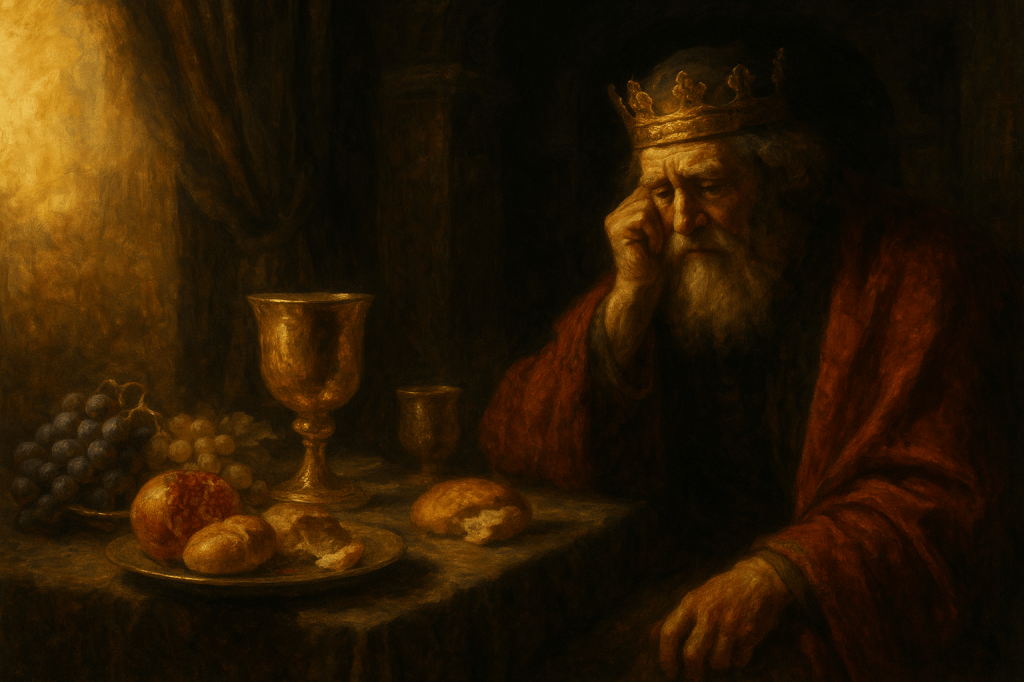
“There is an evil which I have seen under the sun, and it is widespread among mankind:”
“a person to whom God has given riches, wealth, and honor,
so that his soul lacks nothing of all that he desires;
yet God has not given him the opportunity to enjoy these things,
for a stranger enjoys them instead.
This is futility and a severe affliction.”
“If a man fathers a hundred children and lives many years,
however many they may be,
and his soul is not satisfied with good things,
and he does not even have a proper burial,
I say, better the miscarriage than he,”
“for a miscarriage comes in futility and goes into darkness;
and its name is covered in darkness.”
“It has not seen the sun and it has not known anything;
yet it is better off than that man.”
“Even if the other man lives a thousand years twice and does not enjoy good things—
do not all go to one place?”
The Endless Appetite of Humanity
“All a person’s labor is for his mouth
and yet his appetite is not satisfied.”
“For what advantage does the wise person have over the fool?
What advantage does the poor person have
knowing how to walk before the living?”
“What the eyes see is better than what the soul desires.
This too is futility and striving after wind.”
Human Limitation and God’s Sovereignty
“Whatever exists has already been named,
and it is known what man is;
for he cannot dispute with the one who is mightier than he.”
“For there are many words which increase futility.
What then is the advantage to mankind?”
“For who knows what is good for a person during his lifetime,
during the few years of his futile life?
He will spend them like a shadow.
For who can tell a person what will happen after him under the sun?”
Context and Meaning
Ecclesiastes 6 expands Solomon’s theme of vanity by revealing a specific tragedy:
**You can have everything —
and enjoy none of it.**
This chapter shows:
- God can give wealth, honor, success, and legacy…
- But only God can give joy.
Without the gift of enjoyment, abundance becomes torment.
Solomon gives extreme examples:
- A man with riches and honor but no joy
- A man with a hundred children and a long life but no satisfaction
- A man who lives two thousand years but still cannot enjoy good things
The conclusion is gut-wrenching:
A stillborn child is better off — because it never experiences the agony of unfulfilled desire.
Solomon is not devaluing life — he’s exposing the misery of a life lived without God.
Then he turns to the universal condition of human appetite:
“His soul is not satisfied.”
No matter what we feed desire, it always wants more.
Finally, Solomon exposes the limits of human wisdom:
- We cannot dispute with God
- We cannot know the future
- We cannot determine what is truly good for us
- We are shadows — fleeting and limited
Ecclesiastes 6 is the collapse of human self-sufficiency.
Key Themes:
- Blessings Without Joy Are a Curse: Wealth and honor mean nothing without God (v. 1–2).
- A Large Family and Long Life Cannot Satisfy: External blessings cannot fill an empty soul (v. 3–6).
- Human Appetite Is Bottomless: Desire never says “enough” (v. 7).
- Seeing the Present Is Better Than Endless Craving: Contentment is wiser than longing (v. 9).
- Man Cannot Contend With God: We are limited, He is sovereign (v. 10).
- We Do Not Know the Future: Human wisdom cannot secure tomorrow (v. 12).
Reflection and Impact
Ecclesiastes 6 dismantles the modern gospel of “more.”
- Joy is not in possessions – echoes Luke 12:15.
- Only God satisfies the soul – aligns with Psalm 107:9.
- We are not in control – mirrors Romans 9:20: who speaks back to God?
- Life is a vapor – James 4:14.
- Desire is deceptive – Proverbs 27:20; 1 John 2:16–17.
- Blessings without God become burdens – Deuteronomy 28:47–48.
- Contentment is learned, not achieved – Philippians 4:11–12.
Ecclesiastes 6 shows the painful truth:
If you cannot enjoy what you have, nothing you gain next will help.
Application
- Seek God, Not More: Only God can make life meaningful.
- Pray for Contentment: Joy comes from Him, not accumulation.
- Beware the Lie of “Just a Little More”: Desire always moves the goalposts.
- Receive Today as a Gift: What you see now is better than endless craving.
- Walk in Humility: Let God define what is truly good for you.
- Embrace Your Limits: Trust the God who knows the future you cannot see.
- Remember That Life Is Short: Use your days wisely — they pass like a shadow.
Closing Thought
Ecclesiastes 6 is a merciful warning:
A life filled with blessings but void of God is a life filled with sorrow.
But a life filled with God — even with few possessions — is filled with joy.
The soul was made for God.
And nothing under the sun can replace Him.
 TIME FOR PROVIDENCE
Leave a comment