
My wife (Laura) asked me the question, “What are you going to study?” For this new year. So I’ve meditated on that question. I thought… you know, that question is a good one to apply to others:
What are you going to study, Reader?
While Laura asked that question to mean a ‘bible’ study for me, might mean something else entirely for you, e.g. I also want to study psychology. My prayer is, allow me to combine what I learn from the inspiration of the Holy Spirit by the Word of God (in Ephesians) and Psychology to meet the desire of God—who wants all people to be saved and to come to the knowledge of the truth (1 Tim 2:4)—through this online median.

It might be that you’re already on a study relevant to what I’ll be studying and would like company, or it might be that you don’t have a plan for a bible study – in either case I’d love for you to join me!
What am I going to study?
My plan is to study the epistle of Paul to the Ephesians with an 1800’s British theologian by the name of Robert Govett through his book on the Ephesians and a 1900’s Chinese Christian preacher by the name of Witness Lee through his Life-study on the Ephesians from Living Stream Ministry (Biblical perspectives) and Dr. Jordan B. Peterson through his material (Psychological perspective) primarily, but not exclusively.
[Disclaimer: this post includes affiliate links. If you click and purchase I hope to receive a small commission at no extra cost to you.]
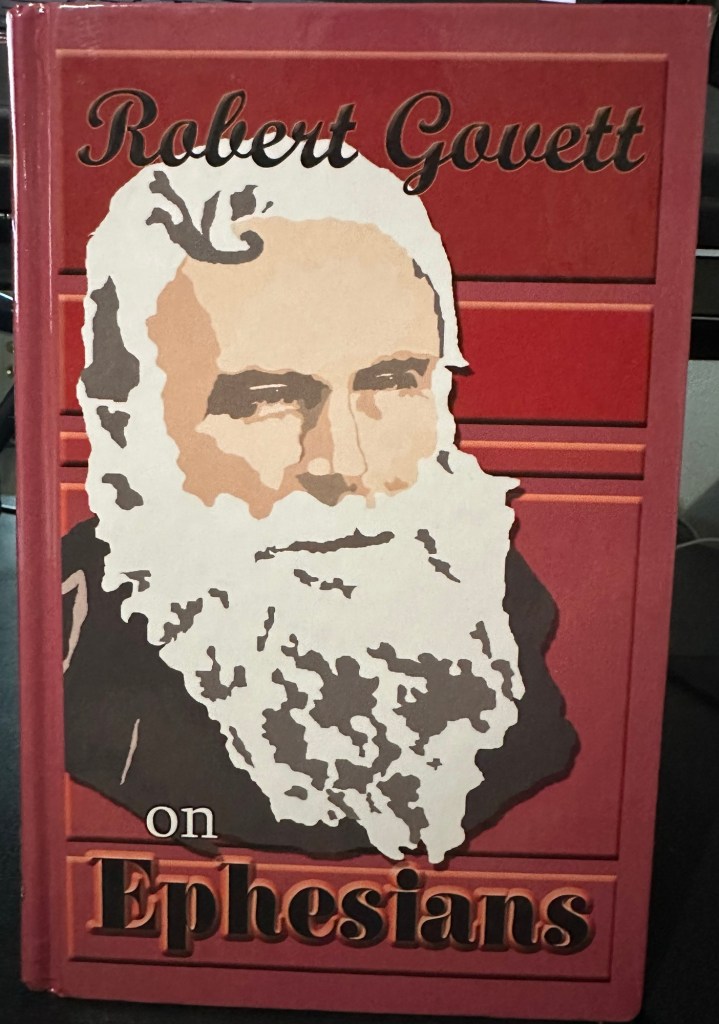
It seems to me clear, that the Epistle was not directed primarily or only, to the believers of Ephesus. It was, as I believe, in common with others, a circular Epistle; and that we find it under another name as the Epistle to Laodiceans. It is observable, that it is not said ‘To the church of Ephesus,’ as Paul generally writes. ”To the Church of God which is at Corinth”—in both the First and Second Epistles. ”Paul” “to the churches of Galatia,” “To the church of Thessalonians” is the inscription on both the First and Second Epistles.
If I mistake not, the words—’in Ephesus’—should be omitted. ’Paul—to the existing saints and believers in Christ.’ So it would be a general Epistle, penned for the Saints of the dispensation. Paul was ‘Apostle to the nations.’ There is nothing in the Epistle that confines it to Ephesus in particular. The so-called ‘Epistle to the Ephesians’ is the Apostle’s letter to believers who had seen his face; while Colossians is especially designed for those whom he had not visited.
Robert Govett on Ephesians, (1981 and 2010, p.2-3)
Looking at the excerpt from Robert Govett above was something that inspired me to share with you; the Epistle to the Ephesians was really the Epistle to you and me—the existing saints and believers in Christ. This Epistle is specifically written for, not just the Ephesians, but for all existing saints and believers of the time.
Mr. Govett approaches the epistle with a question and argument: “WHAT IS THE CHURCH? or the ARGUMENT OF EPHESIANS.” Which is something I’m excited to discover, but my approach to this study is to discover the relationship between the Church and the Holy Spirit for our day and age, and into the future—if the Lord wills.
Why Ephesians?
The reason I wanted to study this Epistle was because of what it addresses (which I plan to post about throughout this year), but the influence that concluded my decision was through reading another blog by a dear brother of mine by the name of Rainer, in Christ, The Devotional Guy. I encourage you to check his site out, you’ll be blessed!
What else am I going to study?
There is another study that I’m doing called:
“The Power of God for Salvation”

I am much more excited about this study than I am on Ephesians.
Why?
Because I believe this study will address a particular issue I have with how the gospel is presented by modern day “Christians”, which not only includes Watermark Community Church where I am a member of the Church in Dallas, Tx., but also how I present the gospel.
An issue I have with myself is that I quickly critique the preacher, and I don’t mean to communicate by any means that I present the gospel in the way that generates the power of salvation—or else I don’t think I would be doing this study. I am convicted to present the gospel accurately, or the power its of is not of God, but of me—which is a gospel in error, and that’s an issue! The apostle Paul wrote to the Corinthians this:
5 Test and evaluate yourselves to see whether you are in the faith and living your lives as [committed] believers. Examine yourselves [not me]! Or do you not recognize this about yourselves [by an ongoing experience] that Jesus Christ is in you—unless indeed you fail the test and are rejected as counterfeit? 6 But I hope you will acknowledge that we do not fail the test nor are we to be rejected. 7 But I pray to God that you may do nothing wrong. Not so that we [and our teaching] may appear to be approved, but that you may continue doing what is right, even though we [by comparison] may seem to have failed. 8 For we can do nothing against the truth, but only for the truth [and the gospel—the good news of salvation].
—2 Corinthians 13 (AMP)
So this study, in a way, is to test and evaluate yourself. Something that I heard from Dr. Jordan Peterson with regard to his new book “We Who Wrestle With God” on the Modern Wisdom channel from YouTube is that he doesn’t think that you’ll be able to read this book and understand it and be atheistic (3:13:16).
I’m hoping that the fruit of this study will produce the same result in addition to the work of the gospel for the salvation of souls, ultimately that disciples are made!
More to come, Reader.
 TIME FOR PROVIDENCE
Leave a comment